
Here’s a way of thinking about your body that is both ancient and, it turns out, measurably true: you are an antenna. Not metaphorically — physically. Your body emits electromagnetic signals, and it receives them too. Every tradition that talks about “energy,” “aura,” or “vibration” was pointing at something real long before anyone had the instruments to prove it. This post is about what that something is, and how you can work with it on purpose.
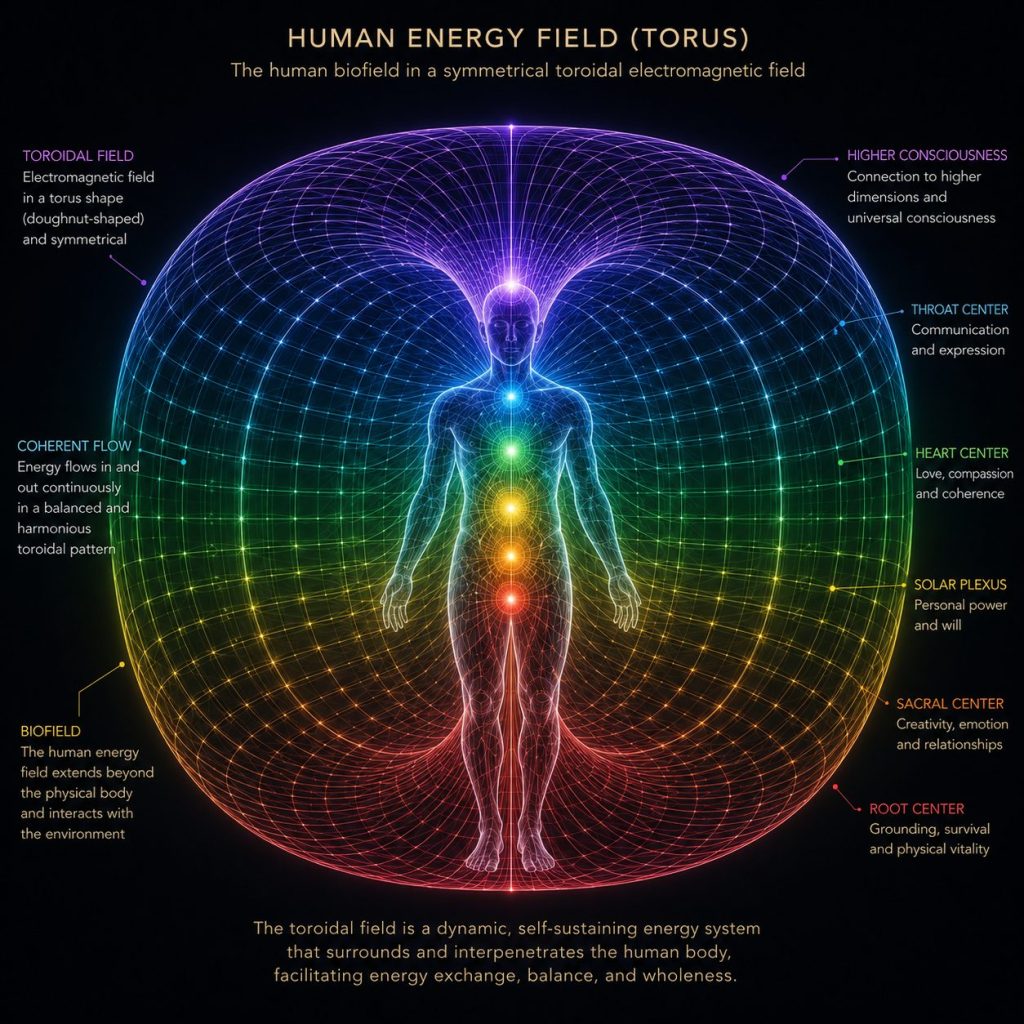
Your body really does act like an antenna
Strip away the mysticism for a second and look at the engineering. Radiofrequency researchers have known for decades that the human body behaves like a lossy conductor — a material that can carry and respond to electromagnetic fields, but that also absorbs and dampens them rather than passing them through cleanly. When you stand on the ground, your body forms something close to a quarter-wavelength monopole antenna. For someone about 170cm tall, that geometry resonates strongly around 44MHz. Zoom out further, and the body shows a broad resonance response spanning roughly 40Hz all the way up to 400MHz, with a well-documented whole-body resonance band around 40-60MHz.
This isn’t fringe science. It’s the same physics behind Human Body Communication (HBC), a real wireless technology that uses the body itself as a signal-transmission medium instead of open air, and behind ambient electromagnetic energy harvesting, where engineers design wearables that pull small amounts of usable power directly from the electromagnetic field the body sits in. If mainstream RF engineers are building real devices around the idea that your body sends and receives electromagnetic signals, it’s worth taking seriously when older healing traditions said the same thing in different words.
The Earth has a frequency too — and so do you
In 1952, physicist Winfried Otto Schumann described something remarkable: the space between the Earth’s surface and the ionosphere acts like a giant resonant cavity, and it rings at a set of specific frequencies. The strongest and most-studied of these — now called the Schumann resonance — sits at 7.83Hz. Our whole planet has a heartbeat, and it has a number.
Here’s where it gets interesting for anyone working with frequency and the body: 7.83Hz sits almost exactly on the boundary between theta brainwaves (4-8Hz, associated with deep meditation, hypnagogic states, and inner focus) and alpha brainwaves (8-12Hz, associated with relaxed, wakeful calm). Researchers have documented this overlap for years. It doesn’t prove that the Earth is “talking” to your brain, and the natural Schumann field itself is faint — far weaker than the artificial signals used in most lab entrainment studies. But the coincidence is real, it’s measured, and it lines up with something meditators and energy workers have described for a very long time: that stillness and grounding seem to happen at a particular, almost tangible frequency.
What entrainment actually means
Entrainment is one of the oldest observations in physics. In 1665, the Dutch scientist Christiaan Huygens noticed that two pendulum clocks mounted on the same wall would, over time, fall into perfect opposite-swinging sync with each other — not because anyone set them that way, but because the faint vibrations passing through the shared wall nudged the slower rhythm to match the stronger one. Rhythms that are close in frequency tend to lock together. It’s a basic property of coupled oscillating systems, and it shows up everywhere from fireflies flashing in unison to your own heart rate syncing to a strong external beat.
Brainwave entrainment applies the same idea to the nervous system. Rhythmic stimulation — sound, light, or pulsed electromagnetic fields — presented at a specific frequency can encourage brain activity to gradually shift toward that frequency. This is genuinely studied territory, most robustly with binaural beats and photic (light-based) stimulation, and it’s the same underlying principle behind PEMF, where a pulsed electromagnetic field is used to encourage the body’s own electrical rhythms to synchronize with it.
Put plainly: your body doesn’t just sit passively in the electromagnetic environment around it. It responds. It has a tendency to fall into step with a strong, steady, nearby rhythm. That’s not a spiritual claim — it’s a description of how oscillating systems behave, and your nervous system is one of them.
Where the Resonator comes in
This is exactly the principle we built the Resonator around. On its own, it’s a piece of sacred-geometry orgonite — a Rodin coil matrix embedded with piezoelectric quartz and other crystals, built to sit quietly in a space the way any orgonite piece does. Connect it to an amplifier and the companion frequency app, though, and it becomes an active tool: a way of choosing a specific pulsed frequency and letting your body’s own antenna-like nature respond to it.
In practice, that means picking a target frequency and sitting with it long enough for entrainment to have a chance to happen — typically several minutes, with the Resonator set in the 1-10Hz range for grounding and calm work, or tuned to one of the higher reference points we use across our chakra and Earth-frequency charts (396Hz through 963Hz for the chakra centers, or reference points like 7.83Hz for Schumann-aligned grounding and 432Hz for general resonance work). You’re not asking the device to do something to you. You’re giving your nervous system a clear, steady rhythm and letting its natural tendency to synchronize do the rest.
This is where we think the spiritual and the scientific stop competing and start describing the same thing from two directions. Call it raising your frequency, call it entrainment, call it nervous system regulation — the underlying mechanism is a body that is genuinely antenna-like, in a field of frequencies it is built to notice and respond to.
A simple way to start
You don’t need to understand the physics to feel the effect, but it helps to know it’s there. Start with a single frequency — Schumann’s 7.83Hz is a gentle, well-documented place to begin — connect your Resonator, and give it ten quiet minutes. Notice what shifts. Then, over time, experiment with the chakra frequencies or the higher reference tones and pay attention to what each one seems to call forward in you. You are not doing something foreign to your body. You’re doing something your body already knows how to do — resonating with the world around it — on purpose, and with intention.