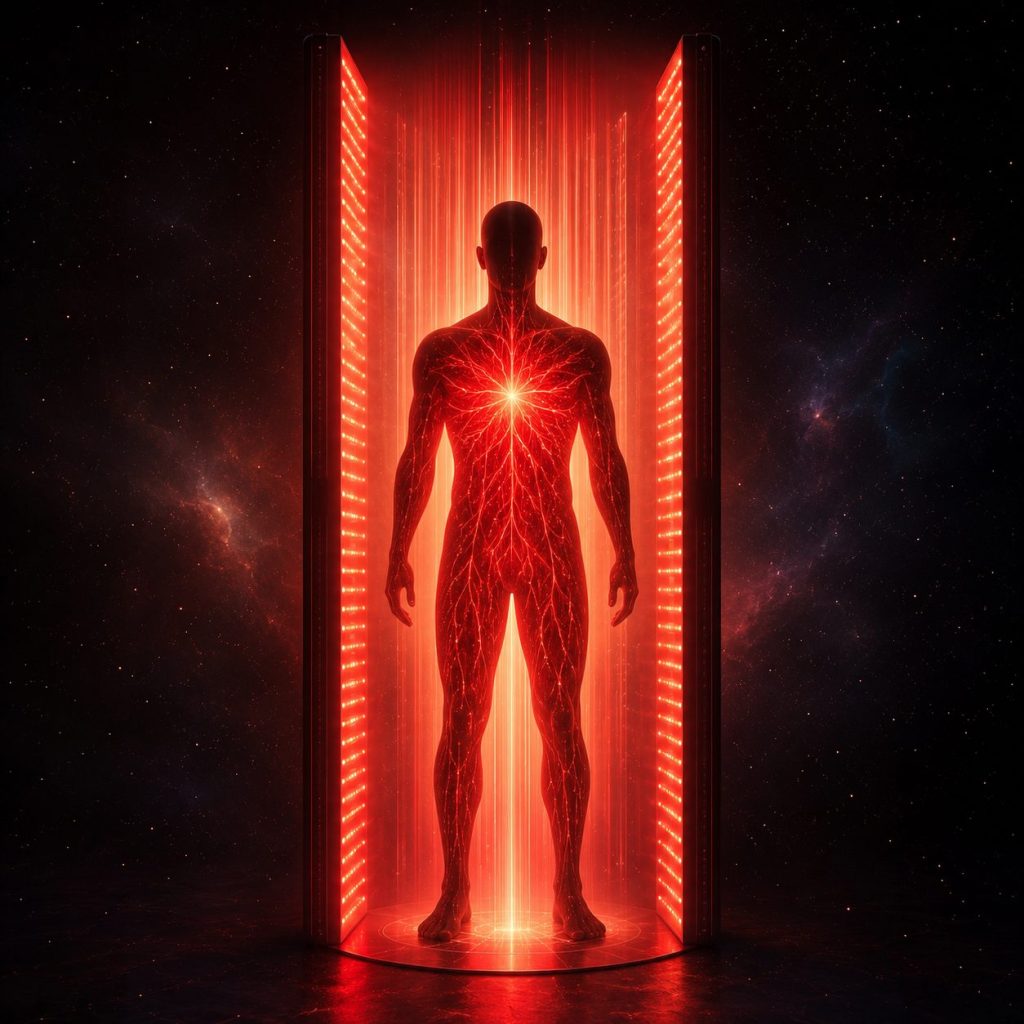
Walk into almost any med spa or recovery clinic in 2026 and you’ll find a red or near-infrared light panel somewhere in the building. The category is projected to hit roughly 9.3 billion dollars this year and nearly double again by 2033, and it’s no longer confined to dermatology offices. Full-body photobiomodulation beds and pods are showing up in wellness clinics, gyms, and recovery centers, often stacked right next to cryotherapy, lymphatic drainage, and IV drip bars.
Photobiomodulation Goes Mainstream
The pitch behind red light therapy is that specific wavelengths of light — usually in the 620 to 850 nanometer range — penetrate skin and reach the mitochondria inside your cells, where they support ATP production, the energy currency your cells run on. It’s the same cellular target PEMF researchers have been studying for years: give the mitochondria a usable signal, and cellular repair processes speed up. Different delivery method, same underlying biology.
Light Is a Frequency, Too
It’s easy to forget that light is just another point on the electromagnetic spectrum — a frequency, measured in nanometers instead of hertz, but governed by the same physics. Red light therapy works because the body is tuned to respond to specific frequencies of light, the same way it responds to specific frequencies of sound, magnetic pulses, or crystal-based resonance. The wellness industry didn’t set out to prove that frequency matters. It backed into that conclusion independently, one modality at a time, because the results kept showing up.
The Stack Approach
What’s notable about 2026’s wellness clinics is how rarely red light therapy stands alone. It’s typically one layer in a broader recovery stack — paired with cold plunge, compression, or lymphatic work — because each modality is hitting a slightly different system. Light for mitochondrial signaling. Cold and compression for circulation. The clinics building these stacks aren’t guessing; they’re responding to a growing body of consumer demand for treatments that do something measurable, not just feel good in the moment.
Where the Resonator Fits
A red light panel is a serious investment, and even a single clinic session adds up fast if you’re going regularly. The Resonator works on the same underlying premise — that the body responds to a consistent, targeted signal — using crystal and copper frequency instead of light wavelength. It’s not a replacement for a photobiomodulation bed. It’s a daily-use tool built for the days you’re not booking a session, keeping that same signal-based approach to recovery going without needing a clinic visit.
Red light therapy’s rise isn’t really about light. It’s more evidence that the wellness industry, however it gets there, keeps landing on the same idea: give the body the right frequency, consistently, and let it do the rest.