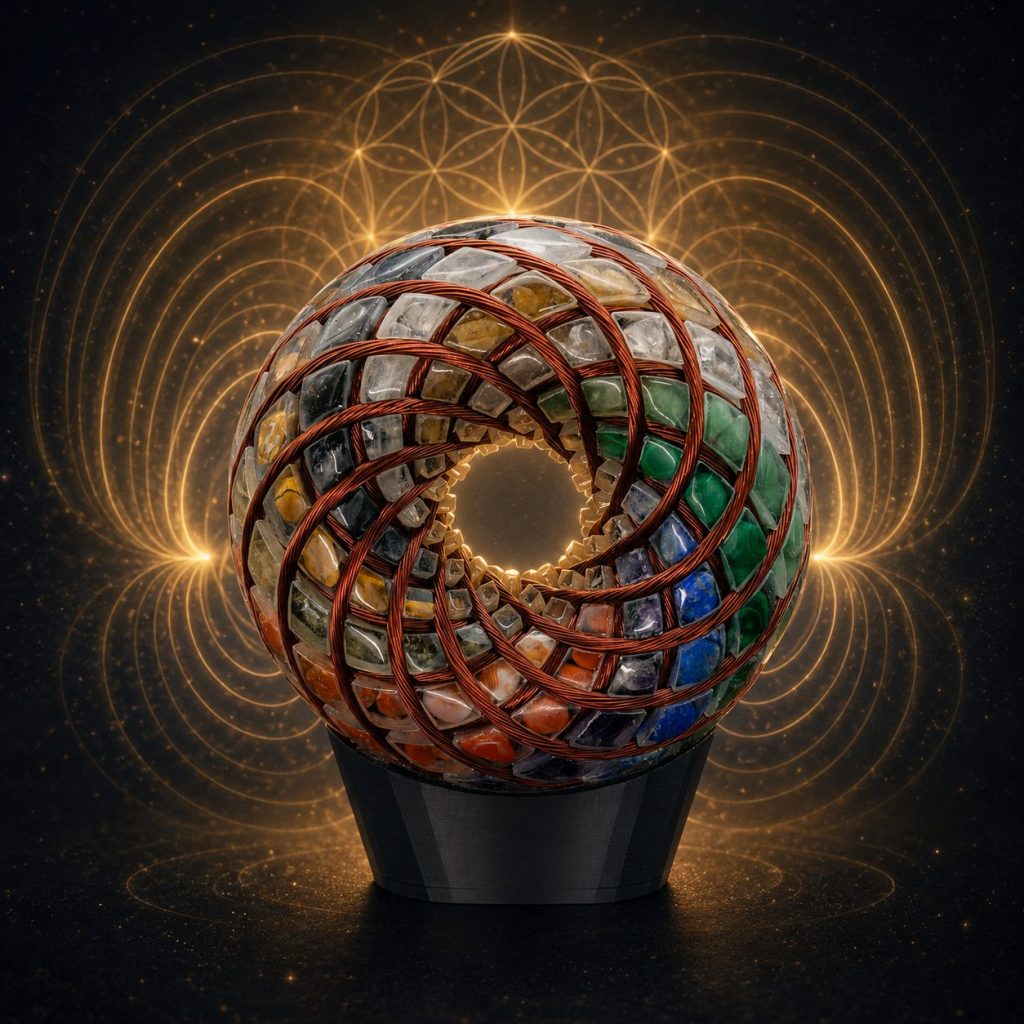
Look closely at a lot of things that move energy well, and you’ll notice they keep choosing the same shape. Your heart’s electromagnetic field forms it. Earth’s magnetic field forms it. Water spins into it when it drains. Galaxies, on the largest scale we can observe, echo it too. That shape is the torus — a donut-like ring where energy flows out through the center, curls back around the outside, and returns to where it started, over and over, in a closed loop.
It’s why our Resonator is wound the way it is. Not because a torus looks striking on a shelf (though it does), but because the shape itself is doing real work — and, we’d argue, it’s the same reason ancient traditions kept drawing it too.
The engineering reason: a torus contains what a straight coil leaks
Wind copper wire into a simple cylinder — what electronics calls a solenoid — and you get a strong, useful field inside the coil, but a messy one outside it. The field has to complete its loop somewhere, and with an open cylinder, that “somewhere” is the surrounding air. Energy leaks out in every direction, weakening fast the farther you get from the coil.
Bend that same coil into a closed ring — a torus — and something changes. The field no longer needs to escape into open space to complete its path, because the coil’s own geometry already brings it full circle. The field stays largely contained within and around the ring itself instead of scattering outward and thinning out. It’s the difference between water sprayed from an open hose and water moving through a closed loop of pipe: same volume, completely different behavior.
That containment is exactly what you want in a wearable energy device. A field that holds its shape and stays coherent close to the body does more for you than one that sprays outward and dissipates before it reaches you. The torus isn’t a stylistic choice sitting on top of the engineering — the shape *is* the engineering.
The sacred geometry reason: this shape has been called the pattern of life for thousands of years
Long before anyone could measure a magnetic field, people were drawing the torus anyway — because they could feel it, watch it, and recognize it as something fundamental. In sacred geometry, the torus is held up as one of the clearest visual expressions of how energy actually behaves: it doesn’t just radiate outward and disappear, it circulates. It expands from a center, curls back around, and returns to that same center to begin again. That’s why the torus has stood, across so many traditions, as a symbol of wholeness, balance, and continuity rather than depletion — energy that sustains itself instead of draining away.
You can see why it resonated. The torus shows up in the human heart’s own energetic field. In the way water naturally spins into a vortex. In planetary magnetic fields. In the growth patterns of certain plants. It isn’t a shape that got imposed onto nature from the outside — it’s what nature reaches for, again and again, whenever energy needs to organize itself into something self-sustaining rather than something that simply scatters and fades.
That’s a pattern worth paying attention to. When the same geometry shows up independently in your own cardiovascular system, in planetary physics, and in millennia of spiritual symbolism, that’s not coincidence stacking on coincidence — that’s a shape the universe keeps reaching for because it works.
Two ways of arriving at the same answer
Here’s what we find genuinely remarkable: an electrical engineer optimizing for field containment and a sacred geometry tradition describing the pattern of universal life arrive at the exact same shape, from two completely different starting points. One got there through equations and measurement. The other got there through observation, intuition, and generations of accumulated wisdom about how energy moves. Neither path needed the other to reach the torus — and yet here we both are, pointing at the same ring.
That’s the whole philosophy behind how we build the Resonator. We don’t think holistic wisdom and technical precision are competing explanations where you have to pick a side. We think they’re two different instruments measuring the same underlying reality — one with oscilloscopes, one with millennia of lived, cross-cultural experience — and when they land on the same shape independently, that’s worth taking seriously rather than dismissing either one.
What this means for the Resonator you wear
Every Resonator is wound as a torus for both of these reasons at once, not one or the other. The copper winding forms a closed ring so the field it generates stays coherent and close, rather than leaking outward and thinning before it ever reaches you. And that same ring is the shape traditions have pointed to for thousands of years as the geometry of sustained, circulating, self-renewing energy — the pattern your own heart is already running.
Wearing a Resonator built on that shape means wearing something that’s contained by design and resonant by design — a piece of engineering that also happens to be one of the oldest symbols we have for energy that flows, returns, and sustains itself. That’s not two separate claims sitting next to each other. It’s one shape, doing what it has always done.