
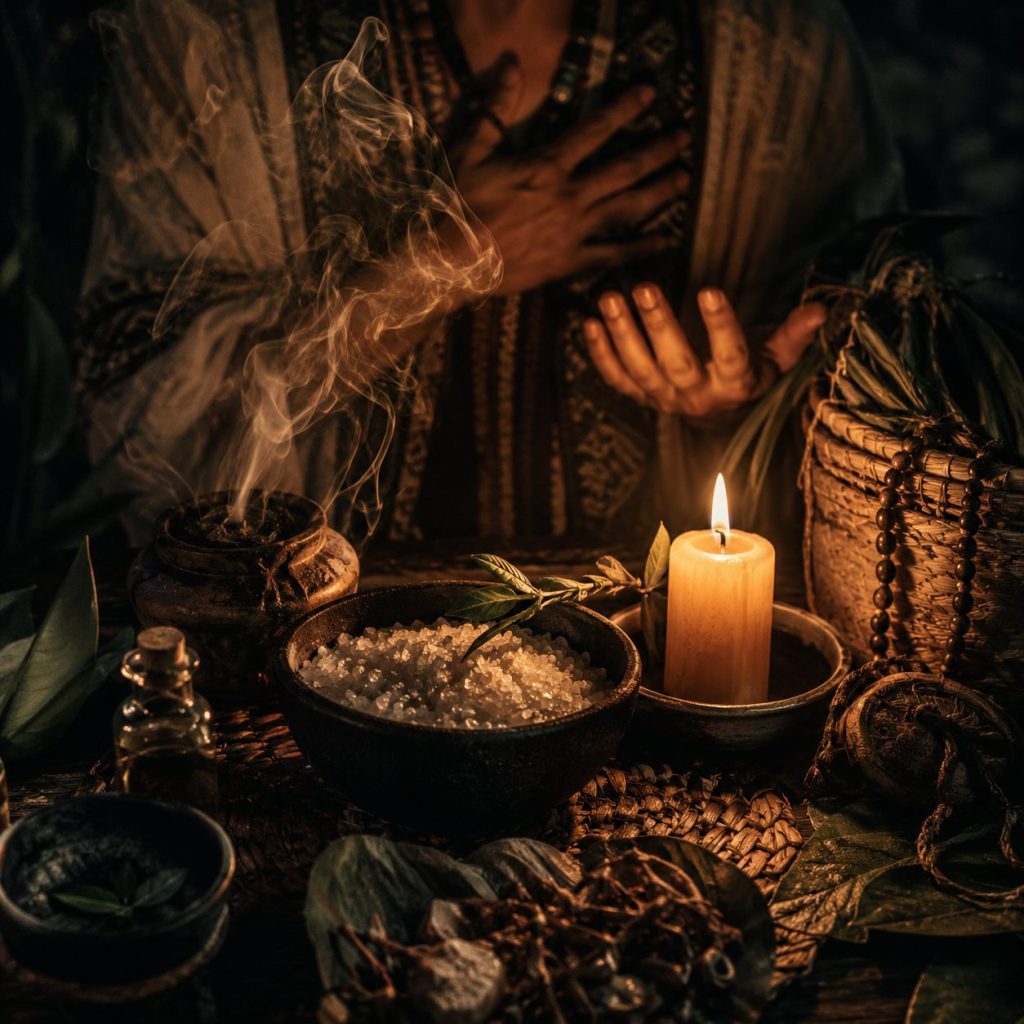
Long before orgonite or PEMF, the Philippines had its own deep tradition of energy work: the albularyo. We think this tradition deserves real respect and real attention on this blog, and we also think it has something to teach us about a step we talk about constantly here — grounding. Here is the honest, researched version of both.
Where the albularyo tradition comes from
The albularyo traces back to the babaylan, the pre-colonial spiritual leaders and healers of the Philippines, most often women, who mediated between the physical and spirit worlds for their communities. Over centuries of Spanish colonization, the tradition absorbed Catholic elements, particularly oracion, devotional prayers, layered onto indigenous practices that never disappeared. What survived is a genuinely blended system: herbal medicine, physical bodywork, and spirit-based diagnosis, practiced side by side.
What albularyo actually do
- Hilot: A form of massage and bodywork, addressing what practitioners describe as urat (nerves and veins), lasag (muscle), and tulang (bone), alongside energetic imbalance.
- Oracion and bulong: Whispered prayers and incantations, often invoking Catholic saints alongside older indigenous forces, spoken over the patient during treatment.
- Pagtatawas: A diagnostic ritual using melted alum or candle wax dropped into water. The shape it forms as it cools is read by the albularyo to identify the cause of an illness, often attributed to spirits like the nuno or engkanto.
Protection is deeply built into the tradition
Filipino folk practice takes protection seriously. The agimat and anting-anting, amulets tracing back to pre-colonial babaylan practice, were carried for protection against illness, misfortune, and harm, and were famously worn by Katipunan revolutionaries who believed them capable of turning away bullets. Protective oracion are recited before and during healing work. This part of the tradition is thorough, well-documented, and clearly still alive today.
Salt: protection and cleansing in one
No single material shows up more often in Filipino folk practice than salt. It is described across pre-colonial belief systems, documented in Visayan, Tagalog, and Ilocano traditions alike, as a deterrent against engkanto, witches, and malevolent spirits. Folk healers have long placed salt on embers during diagnostic rituals, believing it weakens supernatural forces while giving the healer strength. Piles of salt by doorways, salt scattered around a house to send away unwanted visitors or presences, and salt water believed to carry its own medicinal power after a swim, these are not fringe beliefs. They show up across regions and generations, and they were folded into Catholic practice too, through the pinch of blessed salt placed on an infant tongue at baptism.
What we find notable is that salt in Filipino tradition already does double duty: it protects a space from what might come in, and it is also used directly in cleansing and healing rituals themselves. That dual role, protection and cleansing in the same material, is exactly the pairing we think deserves more attention when it comes to the healer own body, not just the home or the diagnostic tool.
The tradition already releases the object, but maybe not the healer
Here is where we want to be precise rather than sweeping. In pagtatawas, once the tawas has been read and used to anoint the patient, it is not kept. It is deliberately discarded, traditionally thrown westward, toward the setting sun. That is a real, existing release ritual, and it tells us the tradition already understands that whatever the tawas absorbed should not linger in the home or in the healing tools themselves.
What we have not found as clearly documented, and what we think is worth naming honestly, is an equally explicit, equally universal ritual for the healer own body afterward. Protection through agimat and oracion is about keeping something from coming in. Releasing the tawas is about not keeping the diagnostic residue in an object. But a healer’s own body absorbs a great deal during a session, through touch in hilot, through sustained attention, through simply standing at the center of someone else crisis, and we think that part of the cycle deserves the same deliberate closing that the tawas already gets.
To be fair, we are sure many individual albularyo already do this in their own way, through personal prayer, washing, or rest between patients. We are not claiming a gap that applies to every healer everywhere. We are naming a pattern we think is worth reflecting on: protection and object-release are both strongly ritualized, while the grounding a healer does for their own body afterward is left more to individual habit than to a shared, named practice.
Why this matters, for healers and for anyone doing energy work
This is not unique to albularyo. Anyone who spends real time absorbing other people pain, whether a folk healer, a therapist, a nurse, or someone doing frequency work with a Resonator, benefits from a closing step that is just as deliberate as the opening one. Protection keeps the wrong things out. Grounding lets go of what you picked up anyway, because some of it gets in regardless of how well you are protected.
A simple closing practice
After any session where you are holding space for someone else pain, whether that is formal healing work or simply a hard conversation with a friend, give yourself the same disposal ritual the tawas gets. Wash your hands deliberately. Spend a few minutes with bare feet on the ground, the same real grounding practice we have written about elsewhere on this blog. Take a salt bath, or at minimum rinse with salted water, drawing directly on one of the oldest and most consistent practices in Filipino folk healing: salt as something that draws out and disperses what does not belong, the same role it plays at the doorway and in the healing ritual itself. If you have a Resonator, a short session at a low, calming frequency works as a modern version of the same instinct: let your own body release what it absorbed, the same way the tawas is thrown toward the setting sun instead of kept on the shelf.
We offer this as a complement to a tradition we respect deeply, not a correction to it. The albularyo were doing real energy work with real ritual precision long before any of the language on this blog existed. We just think the closing step deserves the same attention the opening one already gets.