
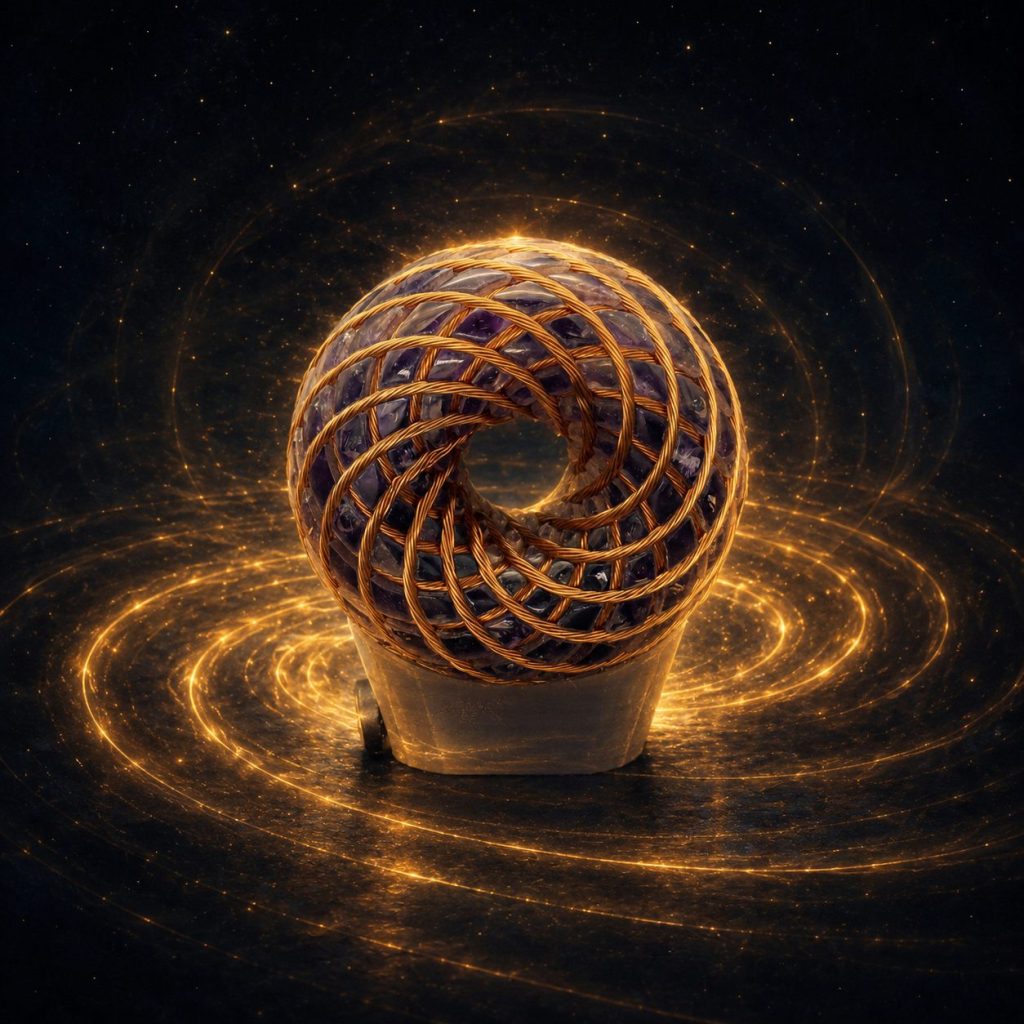
Every Resonator and Copper Pyramid we build starts with the same core piece: a copper coil wound into a torus — a donut shape — with piezoelectric and other crystals embedded through the winding. We’ve written before about the sacred-geometry thinking behind that shape. What we haven’t covered yet is a specific tradition of coil design our shape borrows from: the Rodin coil, and the number pattern underneath it.
Who was Marko Rodin, and what is “vortex-based mathematics”?
Marko Rodin is an American researcher who spent decades developing what he called Vortex-Based Mathematics (VBM) — a way of looking at numbers not as quantities but as relationships, mapped onto a toroidal (donut-shaped) surface. The centerpiece of his system is a simple operation: take the doubling sequence 1, 2, 4, 8, 16, 32, 64… and reduce each number to its digital root (keep adding the digits together until one digit is left — 16 becomes 1+6=7, 32 becomes 3+2=5, and so on). Do that, and the doubling sequence resolves into a repeating six-digit loop: 1, 2, 4, 8, 7, 5 — forever, never landing on 3, 6, or 9.
Rodin mapped that 1-2-4-8-7-5 loop around a circle and noticed it traces a closed, symmetrical path rather than a random scatter. He spent years working with engineers to translate that path into a physical object: a coil wound around a torus core, following the loop instead of a conventional spiral. That object is what’s now called the Rodin coil.
This is the same math behind our 369 post — and that’s not a coincidence
If you’ve read our piece on the 369 manifestation method, this pattern will look familiar. The numbers 3, 6, and 9 are exactly the three digital roots the 1-2-4-8-7-5 sequence never touches. Rodin calls them the “flux field” — a separate axis running perpendicular to the doubling loop, with 9 sitting at the center as the point everything else expands from and returns to. Whether or not you take the metaphysical reading of that seriously, the underlying arithmetic is completely real and checkable with a pencil: digital roots of powers of two cycle through six numbers, digital roots of multiples of three cycle through 3, 6, and 9 alone. That’s modular arithmetic, not mysticism — the mysticism is the layer of meaning people have built on top of a genuine, elegant number pattern.
What’s a tested engineering claim, and what’s still speculation
Here’s where we want to be as exact as we were in our PEMF vs. orgonite post, because Rodin coil claims span a wide range, and they don’t all deserve the same level of confidence.
The winding pattern itself is a real, buildable coil geometry, and independent coil-winders and hobbyist engineers have measured genuinely higher inductance per turn compared to a standard spiral winding of the same wire length — a specific, testable claim about how the current paths reinforce each other around the torus. That part sits on ordinary, well-understood electromagnetism.
What is not established: the claim, popular in some corners of the free-energy community, that a Rodin coil can output more energy than is put into it. No peer-reviewed research or independent lab has demonstrated that, and it would violate conservation of energy if it were true in the way it’s usually described. We’re not going to repeat that claim as fact, the same way we didn’t repeat a fabricated Tesla quote in our 369 post — the real geometry and the real math are interesting enough on their own without needing an overunity claim bolted onto them.
Why this is relevant to the Resonator
Our coil isn’t a licensed, exact Rodin coil, and we’ve never claimed that. What our Resonators and Copper Pyramids share with it is the underlying family of design thinking: a toroidal coil, wound with intention around a shape rather than a plain spiral, with crystals set into the winding itself instead of bolted on as decoration. That’s the same lineage of “the winding pattern matters, not just the wire” that Rodin’s work popularized, applied to our own crystal-matrix design rather than his exact number-loop pattern.
It’s also why the torus shape shows up everywhere in this space — in Rodin coils, in orgonite, in the Resonator — instead of being a purely decorative choice. A torus is the shape a field naturally wants to take when it curves back into itself: field lines exit one side, travel around the outside, and re-enter the other side in a continuous loop. That’s true whether you’re talking about a coil’s magnetic field, a planet’s magnetic field, or the toroidal field some traditions attribute to the human energy body. The shape isn’t arbitrary — it’s what a self-contained, recirculating field looks like, in physics and in the metaphysical models that predate the physics by centuries.
Where this leaves it
We think the Rodin coil is worth knowing about precisely because it sits at the intersection of everything we build around: real modular arithmetic, a real and testable coil-winding geometry, a torus shape that shows up independently in physics and in energy-work traditions, and — yes — a speculative free-energy claim we’re not going to pretend is settled science. Our own coil takes the parts that are real and buildable — the toroidal form, the intentional winding, the crystal matrix — and leaves the overunity claim where it belongs: as an open question for people who want to chase it, not as something we’re selling you.