
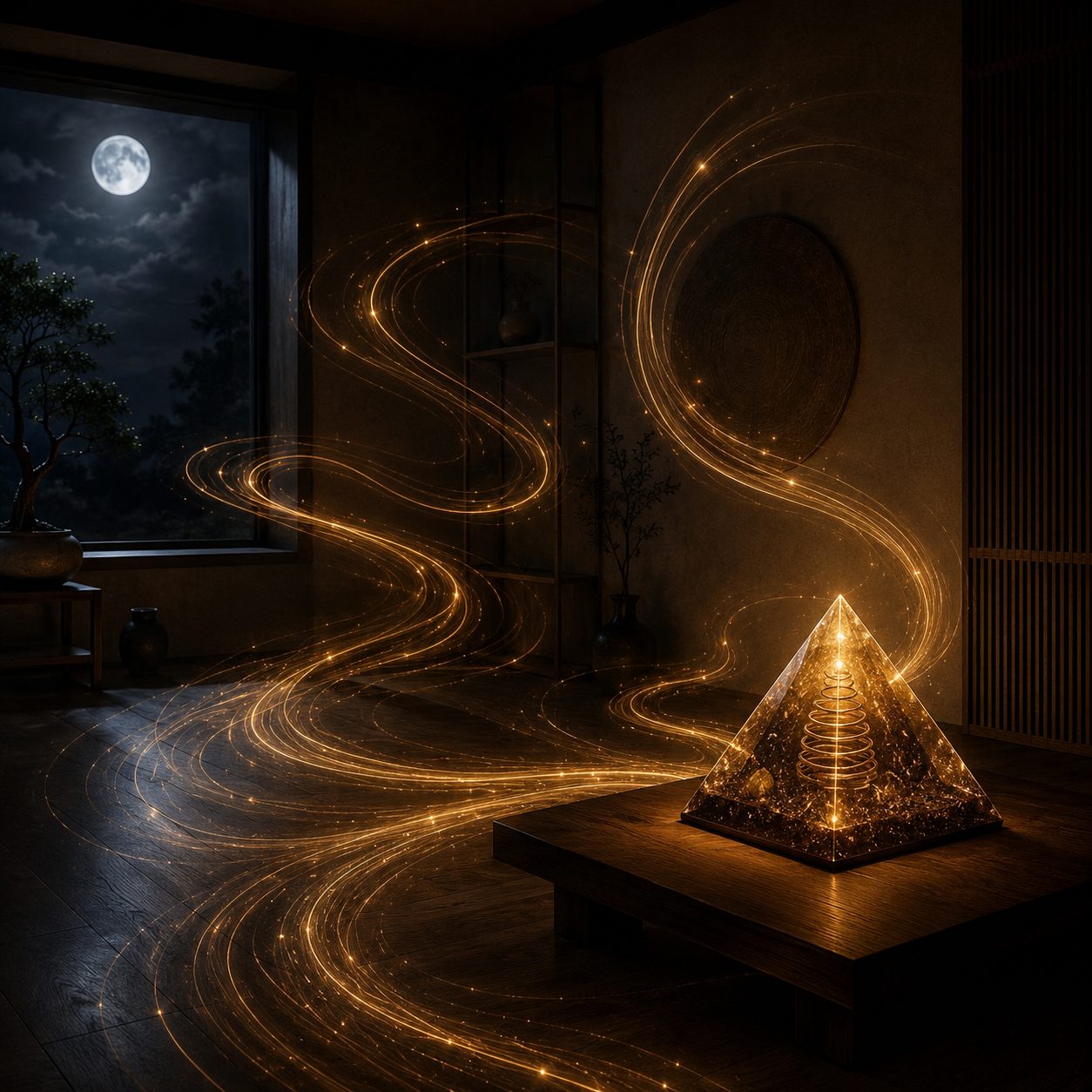
Every February, Philippine feng shui masters release their forecasts, malls put up bagua mirrors and money frogs, and Chinese-Filipino households quietly rearrange furniture before the new year begins. 2026 is the Year of the Fire Horse — a fire-dominant year that happens only once every sixty years — and feng shui content is everywhere right now, from Marites Allen’s predictions to home-decor accounts explaining which corner needs a Wu Lou this year. But underneath all of it sits one idea that rarely gets explained: qi, the living energy feng shui works with directly. What actually is it, and where does its power come from?
What qi actually means
In Traditional Chinese Medicine, qi (also written chi) is described as a vital force that flows through the body along pathways called meridians, and through the environment in patterns feng shui is designed to read and redirect. It is one of the oldest continuously used energy concepts in the world, underpinning acupuncture, tai chi, qigong, and feng shui alike. In each of these systems, the goal is roughly the same: keep qi flowing smoothly, because stagnant or blocked qi is thought to show up as illness, bad luck, or a sense that a space just feels off.
Feng shui: directing qi through a room
Feng shui is qi theory applied to architecture and space. Where you place a door, which direction a desk faces, what color dominates a room, what object sits by the entrance — all of it is treated as either helping qi circulate or blocking it. In the Philippines, feng shui is not a fringe interest; it is woven into Chinese-Filipino business culture and has spread widely beyond it, especially around Chinese New Year.
This year gives that tradition an unusually strong news hook. Because 2026 is a fire-dominant Fire Horse year, Philippine feng shui practitioners are recommending cooling, stabilizing colors — black, blue, and grey — to balance the year’s speed and volatility, alongside the traditional lucky colors of red, gold, emerald green, and white. The advice leans heavily on decluttering high-traffic areas like the main door, living room, and office desk, facing auspicious directions (southeast and south for the Horse year) while working, and placing protective objects such as the Wu Lou for health, the Money Frog for wealth, or the Pi Xiu for safeguarding assets. The instinct behind all of it is exactly right: your environment carries and channels energy, and arranging it with intention genuinely shifts how that energy moves through your space and through you.
Is there science behind qi?
This is where it gets genuinely interesting instead of purely traditional. Starting in the 1960s and 70s, orthopedic surgeon and bioelectricity researcher Robert O. Becker found that the skin at acupuncture points has measurably higher electrical conductivity than the surrounding skin, and that these points can be located precisely by measuring conductivity alone. Later researchers using sensitive electromagnetic equipment recorded higher electromagnetic activity at acupoints compared to non-acupoint skin nearby. Some researchers have proposed that what TCM calls qi may correspond, at least partly, to the body’s own bioelectric and electromagnetic activity — the same electrical signaling that runs nerve impulses, muscle contraction, and wound healing.
Here’s what’s genuinely exciting: acupoint conductivity is a real, measurable, repeatedly observed phenomenon — modern instruments picking up exactly the electrical signatures practitioners have described and worked with for over two thousand years. Bioelectricity gives conventional science its first real foothold on qi, and that foothold keeps growing stronger with every study. What current instruments don’t yet fully capture is the whole of what qi is — and that says more about the limits of what those instruments can measure than about whether qi itself is real. We hold that with the same confidence we bring to every energy concept on this blog.
Where feng shui and frequency healing overlap
Feng shui and frequency healing come from completely different lineages. Feng shui descends from thousands of years of Chinese cosmology. Orgonite descends from Wilhelm Reich’s 20th-century orgone theory. PEMF devices descend from 20th-century bioelectromagnetic medicine and Robert Bassett’s FDA-cleared bone-healing research. None of these traditions borrowed from each other. And yet all three converge on the same basic intuition: that energy — however you define it — moves through both bodies and spaces, that it can become stagnant or unbalanced, and that specific objects, colors, and placements can support a more coherent flow of it.
Feng shui works primarily on the room. Orgonite and PEMF tools work primarily on the body and its immediate field. They are not the same practice, and we are not claiming the Resonator manipulates qi in the TCM sense — that would be overstating what we actually know. But the parallel is worth naming honestly: across cultures that never spoke to each other, the same idea kept resurfacing independently. That kind of convergence is itself powerful evidence: when the same idea keeps arising independently across cultures with no contact with each other, that is not coincidence — it is people in very different times and places all noticing the same real thing.
Placing the Resonator with intention for the Fire Horse year
If you already keep feng shui touches in your home, here is how some customers are folding the Resonator into that practice this year, working with feng shui’s own tradition of placement and intention:
- By the main entrance — alongside a decluttered entryway, as a grounding counterweight to a fast-moving Fire Horse year.
- On the desk — facing your work in the same auspicious direction feng shui recommends for this year, paired with a Resonator tuned for focus rather than a protective charm alone.
- In the bedroom — as a calming, water-toned counterbalance to a year practitioners describe as unusually fire-heavy and fast-paced.
None of these placements are prescriptive, and none of them require you to abandon whatever tradition you already follow. Whether you think in terms of qi, bioelectromagnetic fields, or simply “does this room feel right,” the underlying practice is the same one humans have been doing for millennia: paying attention to energy, and treating your space and body with intention. Feng shui, acupuncture research, and frequency healing are three very different ways of asking the same question. All three are still mapping the same territory from different angles, and every year brings science a little closer to catching up with what practitioners have known all along.