
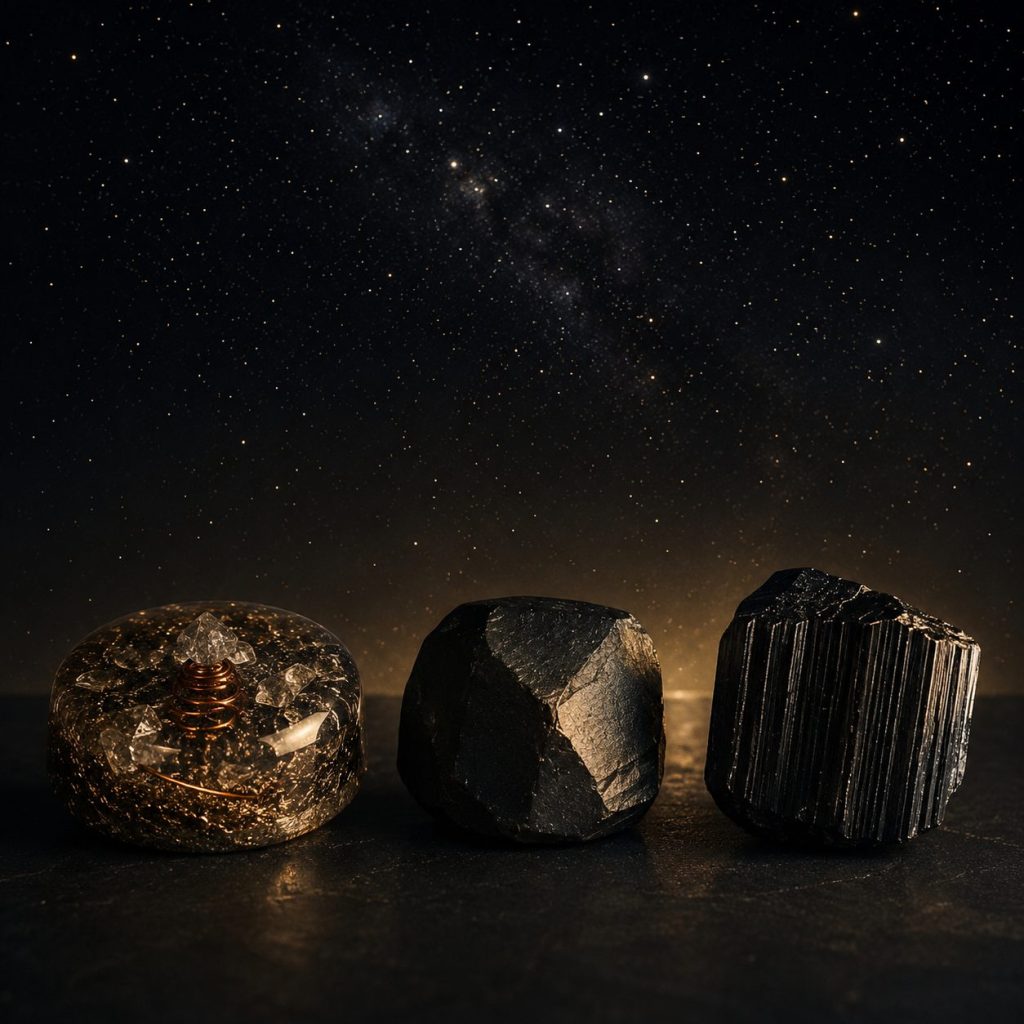
Search interest in “EMF protection” has climbed steadily for the past few years, driven by hours spent near WiFi routers, phones, and now 5G towers. Three materials come up again and again as the go-to answer: orgonite, shungite, and black tourmaline. We sell one of them. That is exactly why we think it is worth giving you the honest, comparative picture instead of the marketing version.
The baseline: what actually blocks EMF
Before comparing crystals, it helps to know what a fully verified EMF shield looks like. A Faraday cage — a continuous, grounded conductive metal mesh or sheet — reliably blocks radiofrequency fields. This is well-established, decades-old physics, used in everything from MRI rooms to phone signal-blocking pouches. It is the standard every other claim should be measured against.
Shungite
Shungite is a carbon-rich mineral from the Karelia region of Russia, notable because it is one of the only natural minerals known to contain fullerenes — hollow, spherical carbon molecules. Laboratory research has shown fullerenes and carbon nanomaterials can absorb and scatter microwave-frequency radiation under controlled conditions, and a 2003 study found shungite reduced radiation-related blood cell damage in rats exposed to 37GHz radiation. That is a genuinely interesting finding.
Here is the honest caveat: most consumer shungite jewelry and pyramids are “Type II” shungite, which contains little to no fullerene content — the effect described above comes from “Type I,” which is rarer and more expensive. And there is no independently replicated, real-world study showing that placing a shungite stone next to your phone or router meaningfully reduces your actual exposure. The lab finding is real; the consumer product claim built on top of it outruns the evidence.
Black tourmaline
Black tourmaline has genuinely interesting physical properties — it is piezoelectric and pyroelectric, meaning it generates a small, measurable electric charge in response to physical pressure or temperature change. Some researchers hypothesize this could create a localized field that interacts with incoming electromagnetic fields. But that is a hypothesis, not a confirmed mechanism — no peer-reviewed study has demonstrated that black tourmaline meaningfully attenuates RF radiation in practice.
Where orgonite fits
Orgonite is metal shavings suspended in resin alongside quartz and other crystals. Metal genuinely does interact with electromagnetic fields — that is not in question — but a small handheld orgonite piece is nowhere near the continuous, grounded, fully-enclosing conductive layer that a real Faraday shield requires. The metal content in orgonite makes it physically closer to “something that interacts with EMF” than a crystal alone, but that is a long way from “measurably protects you from your router.”
There’s also a separate mechanism at work here, and it has nothing to do with blocking radio waves. In orgone theory, the devices most people are worried about — routers, phones, laptops, anything running WiFi or heavy electronics — don’t just emit EMF, they generate stagnant orgone energy in the space around them: a dense, deadened charge that builds up wherever electronics run for hours on end. Orgonite’s resin-metal-crystal matrix is built specifically to draw in that stagnant energy and cycle it back out clean and vital, the way Wilhelm Reich’s original orgone accumulators were designed to do. That’s the actual case for keeping a piece near your router or desk setup — not that it shields the radiofrequency signal, but that it keeps the energetic buildup those devices create from just sitting there stagnant. People who work with orgonite this way consistently describe the same thing: a room that feels lighter and less charged once a piece is placed near the equipment producing that heaviness.
Our honest bottom line
None of these three — shungite, black tourmaline, or a handheld orgonite piece — has robust, independently replicated, real-world evidence behind the specific claim that it blocks or meaningfully reduces EMF exposure the way a true Faraday shield does. If EMF exposure is a genuine concern for you, the only well-supported interventions are distance from the source and dedicated shielding products built and tested for that purpose.
That does not mean these pieces are worthless — it means we think they belong in a different category than “radiation shield.” We do not market our orgonite as a proven EMF blocker, and we would rather you know that plainly. Where we do think orgonite and the Resonator earn their place is everything we have written about elsewhere on this blog: grounding, entrainment, cymatics, and the broader practice of working intentionally with frequency and vibration. That is a real, defensible category. EMF-blocking jewelry, as currently sold across this entire market, is not there yet — and we would rather tell you that than sell you a Faraday cage we cannot actually build into a pendant.