
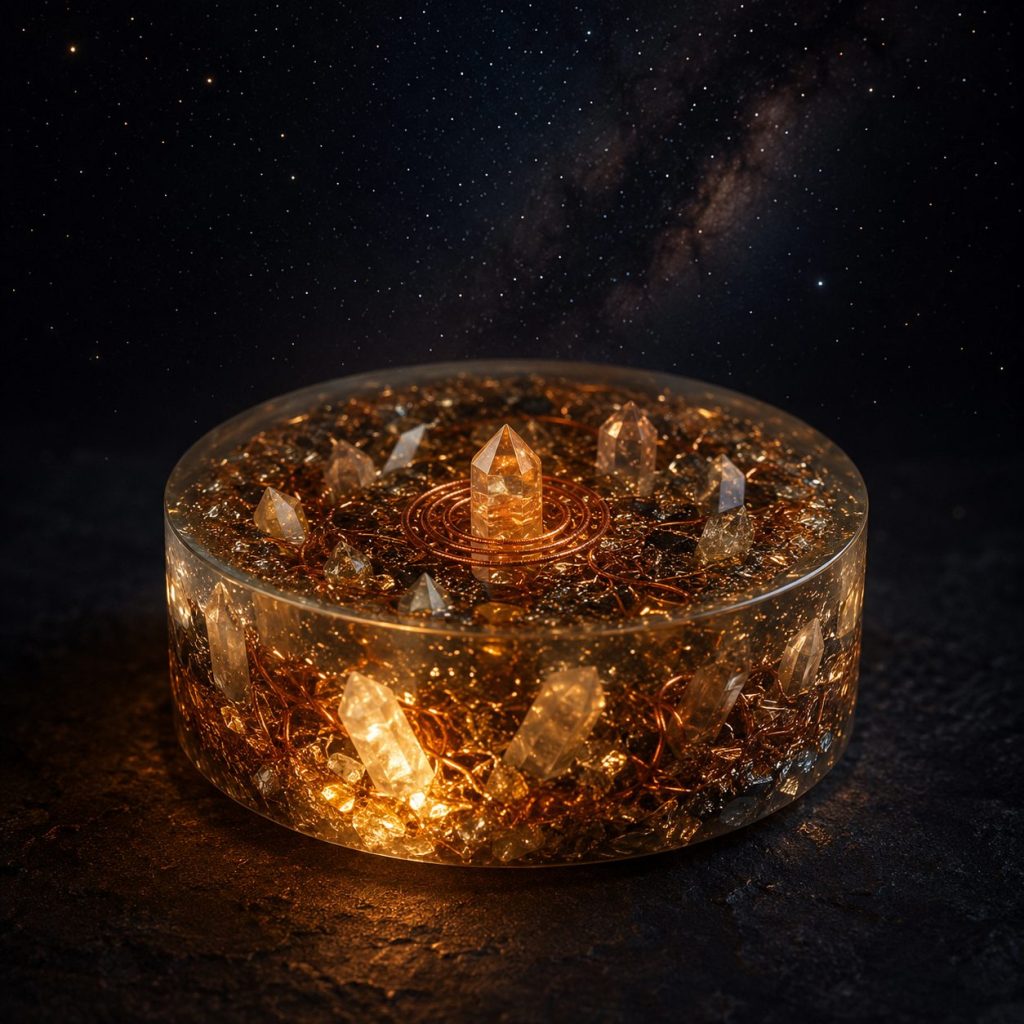
“How do I know if my orgonite is real?” is one of the most common questions in this space, and for good reason. The market is flooded with resin-and-crystal pieces marketed as orgonite that have little to do with the original recipe. Since we make ours by hand, layer by layer, in Calamba, we get asked this constantly. Here is the honest checklist.
What real orgonite is actually made of
Wilhelm Reich’s original concept, and the recipe the orgonite community still follows, calls for roughly equal parts metal and organic/resin material, layered with quartz or other crystals. The metal is meant to be “atomized” — reduced to tiny, fine particles rather than a handful of coarse shavings — so it distributes evenly through the full volume of the piece rather than settling in clumps or a thin layer at the bottom.
Signs you are looking at the real thing
- Even metal distribution: Look through or around the piece for metal that is spread consistently through the whole volume, not concentrated in one spot or barely present.
- No rust or discoloration: Properly sealed metal inside quality resin should not show rust spots or streaking over time.
- Real weight: Metal is dense. A genuine piece should feel noticeably heavier in your hand than its size suggests — a light, hollow-feeling piece is a red flag.
- Small, evenly distributed air bubbles: A few tiny, consistent bubbles are normal in hand-poured resin. Large, irregular pockets of air usually mean a rushed pour.
- Precise geometry: Pyramids and coils should hold clean angles and symmetry. Sacred-geometry pieces in particular, like a Rodin coil matrix, depend on that precision to mean anything at all.
What “fake” usually looks like
In our experience, most of what gets mislabeled as orgonite falls into one of three categories: gemstone or resin art pieces with no metal content at all, simply rebranded as orgonite because the term sells; pieces with a token scattering of metal shavings, added for looks rather than function; and mass-produced pieces that cut corners on both metal quantity and crystal quality to hit a lower price point. None of these are dishonest to enjoy as decor — but they are not doing what orgonite is supposed to do, and you deserve to know the difference before you pay for it.
How we build ours
Every Resonance PH piece is built layer by layer, by hand, around a coil matrix embedded with piezoelectric quartz and other crystals. We are happy to have that construction held to the checklist above — even metal distribution, real weight, precise geometry, no shortcuts. If you are shopping anywhere for orgonite, ours included, we would rather you go in knowing exactly what to look for than take a seller’s word for it.